Separate copyright ownership from the contract’s licensed scope.
Distinguish a required writing from an integrated agreement.
Analyze pressure and mistake with facts, rather than slogans.
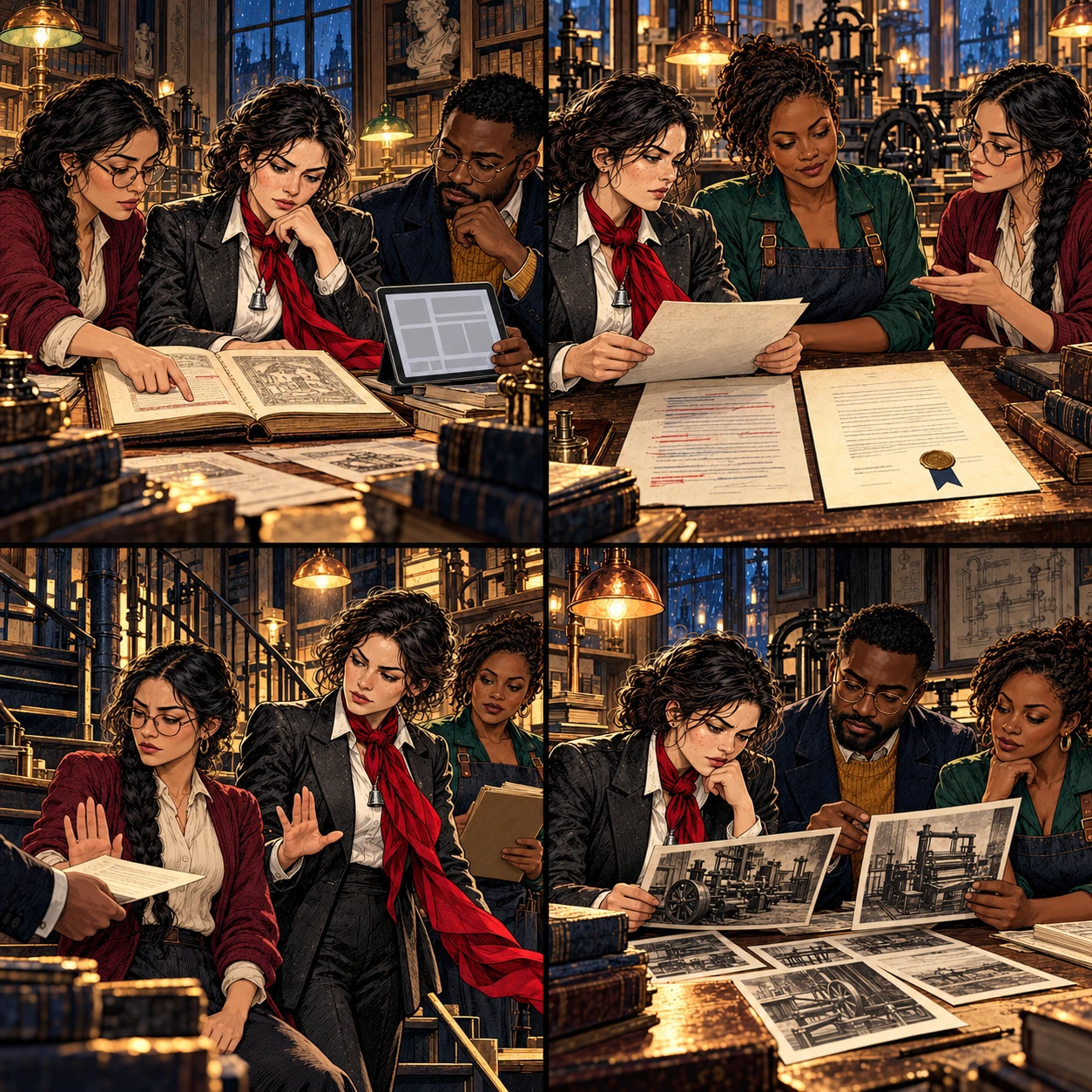
SCENE 1 · SEPTEMBER 14 · THE ARCHIVE ROOM
Eight Hundred Means Eight Hundred
Lucía owns the original text and photographs identified in the license schedule. Her signed nonexclusive license permits one print edition of eight hundred copies for $4,000. Harbor’s proposed promotional draft also calls for an online edition. That use is outside the agreed license.
LUCÍA
I agreed to this print edition. I did not grant an online edition.
DANIEL
Our marketing draft assumed we could put the whole book online.
ELENA
A useful idea is not a granted right. We need permission or a plan within the existing license.
MAYA
We can promote excerpts only if Lucía approves the actual use.
SCENE 2 · SEPTEMBER 14 · A COMPARISON OF DRAFTS
The Final Document
Maya recalls an early email mentioning 'all formats.' The final signed license deliberately limits the project to eight hundred printed copies and contains an integration clause. Elena compares the negotiation history with the adopted language and the applicable evidence rules.
MAYA
This first email sounds broader.
ELENA
The signed final scope is narrower. A final agreement changes how earlier proposals may be used.
LUCÍA
I narrowed it before signing. That was the price of saying yes.
ELENA
Interpretation and admissibility still depend on the governing law. An integration clause does not answer every exception.
SCENE 3 · SEPTEMBER 14 · THE WORKSHOP STAIRS
The Deadline Is Not Consent
Maya asks Lucía to add digital rights immediately because the launch is close. Lucía has her own adviser, who requests time to review the proposed amendment. Elena stops Maya from treating the deadline as a substitute for an informed agreement.
MAYA
We only have a few days. Could you sign this now?
LUCÍA
My adviser has not reviewed it. I am not signing today.
ELENA
Then there is no amendment today. I represent the press, not Lucía.
MAYA
We keep the print plan and negotiate separately if we both want more.
SCENE 4 · SEPTEMBER 15 · ELENA’S OFFICE
What the Record Does Not Prove
Maya suspects Graham never intended to supply the press. Amir’s preserved maintenance and availability records show Rivet had a suitable machine when it accepted the order. Later conduct may establish breach; it does not by itself prove fraudulent intent at formation.
MAYA
He wants more money. Was the original promise a fraud?
AMIR
The dated inventory shows the machine was available when he signed.
ELENA
Breach and fraud have different elements. We plead what the evidence can support.
MAYA
Then the strongest case may be the plain promise he refuses to keep.
THE LAW BEHIND THE STORY
Contracts study notes
Check statutory formalities
Commonly enacted UCC 2-201 generally requires a sufficient signed writing for goods contracts of $500 or more, subject to exceptions and local changes; quantity constrains enforceability. Other statutes govern certain land agreements and agreements not performable within a year. Electronic records require validity and attribution. Copyright transfers have their own rules: a nonexclusive license is distinct from a transfer of copyright ownership.
Interpret the terms actually adopted
Identify the agreement’s text, incorporation, ambiguity, context, and governing interpretive rules. Course of performance, dealing, and trade usage can matter under Article 2. The parol-evidence rule addresses the effect of a final writing on earlier or contemporaneous terms, not all outside evidence. Integration, consistent additions, fraud exceptions, and interpretive evidence require jurisdiction-specific analysis.
Analyze defenses individually
Material misrepresentation inducing justified reliance may make an agreement voidable; fraud adds its own requirements. Mutual mistake concerns a qualifying shared mistaken basic assumption and risk allocation. Unilateral mistake usually needs further conditions. Duress requires more than a stressful deadline. Capacity, illegality, and unconscionability have distinct standards and remedies; identify facts supporting each element.
A signature has legal consequences
Void and voidable are different classifications. Rescission, ratification, restitution, waiver, and third-party rights can affect the result. A signer’s failure to read is not a universal escape; deception or other recognized grounds still warrant analysis. Lucía refuses the new amendment, so this case does not assume a coerced signature must later be unwound.
Change one fact
Change one fact: the parties knowingly sign a later amendment granting an agreed digital edition for additional payment. Does the parol-evidence rule automatically forbid proving that later agreement?
Yes, because no evidence outside the first writing can ever be considered.
No. A later modification is a separate inquiry, including assent and applicable formalities.
Yes, because an integration clause permanently bans all future changes.
Reveal the answer and explanation
B. The rule addresses earlier or contemporaneous terms in relation to a final agreement. Later modification, no-oral-modification provisions, consideration or Article 2 rules, and relevant statutes must be analyzed separately.